Bending Spoons: inference cost per pull request down over 90% from its peak
Bending Spoons’ Q3 2026 results show more pull requests per engineer at a lower inference cost per pull request. What its model-routing approach means for private AI in your company.
Editorial analysis and illustrative technical scenarios. They do not define the features or integrations included in a UTOMAI subscription. See Private AI On-prem pre-launch information.

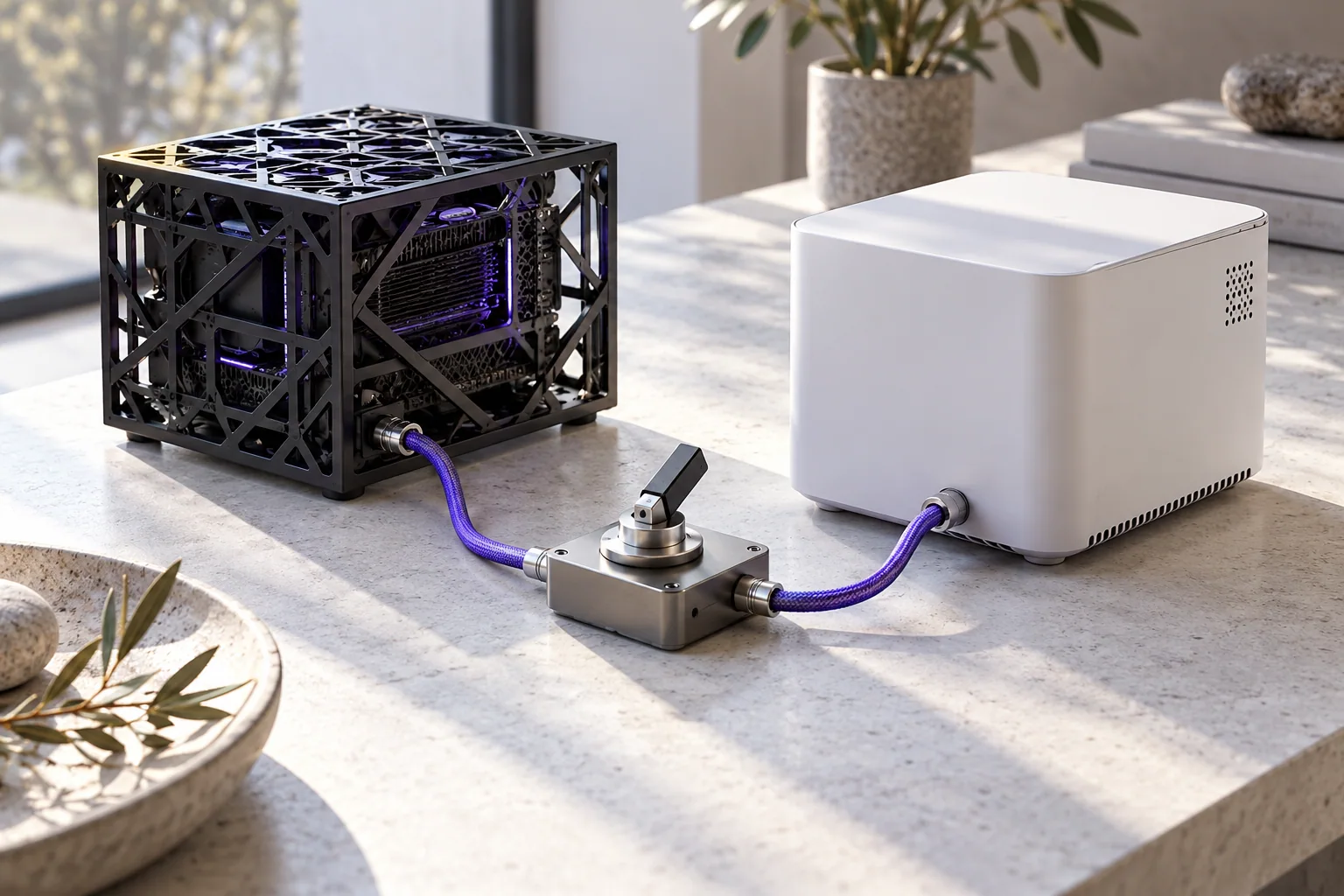
AI-generated editorial illustration. Not a product photograph or a customer case study.
Bending Spoons published its Q3 2026 results on 19 November. One disclosure matters well beyond software engineering. Since the start of the year, the company reports more than four times as many pull requests per engineer, while the inference cost per pull request has roughly halved. Our reading is that the lesson concerns how the work is organised, not only which model is used.
What Bending Spoons reported
According to the company, pull requests per software engineer have more than quadrupled since the start of 2026, and inference cost per pull request has fallen by roughly half. Measured against its mid-year peak, the cost per pull request is down by more than 90%. The company also states that 98% of its pull requests are written in full or in part by AI.
These are company-reported figures. Bending Spoons has not published a complete method for the cost calculation, and UTOMAI has not verified the numbers independently. They are a useful signal of direction, and the reasoning below does not rest on any single figure.
The advantage sits in the harness
The company credits part of this result to a proprietary orchestration layer, which it describes as built on open-source components and independent of any single model provider. For each task, it selects a model by balancing effectiveness against cost:
- Self-hosted, open-weight models handle most tasks.
- More expensive closed-weight models handle the most complex or highest-stakes work, and they also supervise the less advanced models.
- Because the harness works with any provider, the company can change models without rebuilding its workflows.
Inference runs on Pantheon, Bending Spoons’ proprietary GPU inference platform. Pantheon serves the company’s products, scales compute automatically and distributes work across GPUs with minimal overhead. The company therefore controls both the routing decision and the infrastructure behind its open-weight models.
Unit cost and total spend are different measures
This is the part of the story that needs careful reading. Four times the output at half the unit cost still means a larger total inference bill, roughly twice the spend per engineer. That can be a good trade when the output is valuable, but it has to be budgeted and measured as a whole.
For a business, two numbers matter. Cost per completed result shows whether the system is becoming more efficient. Total monthly spend shows what the organisation must fund and whether capacity is sufficient. Both are needed to make a sound decision.
What this means for SMEs
Bending Spoons operates at a scale most small and medium companies will never reach. Its principles still transfer:
- **Route by task**. Use an open-weight model for routine, document-based work where the data should stay inside your infrastructure. Reserve external frontier models for tasks where a measured gain in quality justifies the cost.
- **Measure the unit of work**. Calculate what a completed answer, draft or processed document costs, including the time people spend checking it.
- **Keep the orchestration yours**. A workflow tied to a single provider’s API is hard to move. Separating the workflow from the model keeps future choices open.
Self-hosting has its own costs: capacity, maintenance and operating work. Light or intermittent usage can favour a consumption-based service, while steady demand can make dedicated capacity worth evaluating. The right answer comes from measuring your own tasks, not from someone else’s benchmark.
UTOMAI’s view
Private AI brings this approach within reach of companies that do not run their own GPU fleet. UTOMAI Cloud AI runs on dedicated cloud servers in Italy. UTOMAI Private AI On-prem, which is in pre-launch, places a dedicated machine at the customer’s premises. In both cases the environment combines a shared workspace, knowledge drawn from approved documents, configurable agents and models selected for each task.
Bending Spoons’ results come from engineering choices built over several years, so they cannot simply be copied. What can be adopted is the discipline behind them: define the task, choose the model for it, measure the outcome and keep the decision under your control.
Your data. Your infrastructure. Your AI.
Discover how to design a private AI infrastructure for your company.
Sources
Primary source: Bending Spoons Q3 2026 results, in particular the Other highlights section, and the Q3 2026 prepared remarks. The description of Pantheon comes from Bending Spoons’ website.
The figures above are Bending Spoons’ own. The analysis of what they mean for SMEs and for UTOMAI is our editorial assessment. Bending Spoons is not presented as a UTOMAI customer or partner.